
Tuesday, June 10, 2014


(WEEK 12) Research and inspiration
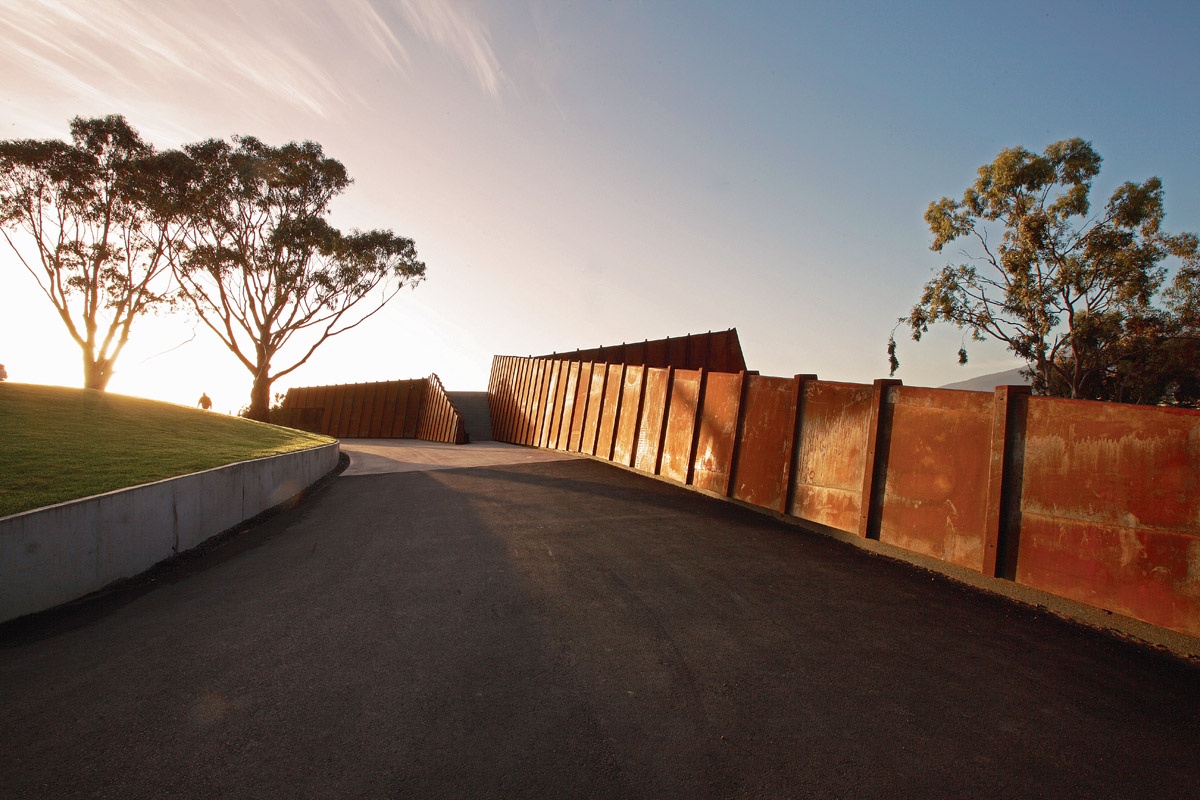
Corten Steel:
I've decided to use corten steel paneling to clad my main museum building. Aesthetically I think the rusty red brown tones are appropriate for Pomonas rural context, plus its an appropriate sheet size to clad a building of this scale.
http://cortenaustralia.com.au/cladding-profiles.html

Possible door design for theater
Being that the door for the theatre is floor to ceiling roughly 8000 tall designing the mechanism for it to function is difficult. Options are for a roller style, large sliding or my preference which is a door hinged at the top that swings up. My preference for one that swings upward is to pay homage to that old style garage door that was common when I was young which while I'm sure was not exclusive to Australia does conjure particularly aussie images for me. One that folds in on its self as demonstrated is a must due to the size of the door and the space I've allocated.
I've decided to use corten steel paneling to clad my main museum building. Aesthetically I think the rusty red brown tones are appropriate for Pomonas rural context, plus its an appropriate sheet size to clad a building of this scale.
http://cortenaustralia.com.au/cladding-profiles.html
Possible door design for theater
Being that the door for the theatre is floor to ceiling roughly 8000 tall designing the mechanism for it to function is difficult. Options are for a roller style, large sliding or my preference which is a door hinged at the top that swings up. My preference for one that swings upward is to pay homage to that old style garage door that was common when I was young which while I'm sure was not exclusive to Australia does conjure particularly aussie images for me. One that folds in on its self as demonstrated is a must due to the size of the door and the space I've allocated.

(WEEK 11) Rough form model


(WEEK 10) Tutorial Feedback
Moving on from my second submission I made some alterations to the layout of my museum which will improve its functionality and build upon my theme from my original node which was kinetic architecture and flexible spaces.
(0.3).jpg)
Changes:
The offices and storage have been moved to the south eastern side of the building and arranged to form a semi private courtyard area which allows light to penetrate into the far corner of the exhibition space.
This now means that the front exhibition space can now open directly onto the main outside area via a large rotating portion of wall that connects it with the cafe and theatre areas.
The community room beside the theatre has been moved north creating another courtyard area space, plus allowing the now adjacent community rooms to be opened into each via large sliding doors to accommodate a variety of uses.
The theatre now features a large garage type door that opens onto the main outdoor area so that performances conducted on the stage can either face inwards or outwards depending on the desired use.
Tutor Feedback:
Received positive feed back for the changes, suggestion was to create a form model for next week to begin to gauge an idea of the size of the buildings in relation to one another and begin researching materials.
Sunday, April 27, 2014


(WEEK 07) Alvaro Siza, Serralves Museum
Alvaro Siza is a Portuguese architect, and the Serralves museum was a design he did in Oporto in 1997. What siza does really well, and what the images show, is how he manages to filter light through the roof, so that the space is naturally lit, but the works on display are not subjected to harsh direct light. A technique he uses is dropped ceilings, which I'd like to investigate using in the design of my own museum.


(WEEK 06) Area Adjacencys and
With a wide variety of spaces and uses in the building i thought it would be valuable to diagram how the different spaces relate to each other and begin to understand how the building might fit together.
 Once I'd done that I could begin overlaying these scaled areas on to the site to fit them together in scale.


(WEEK 06) Site model
Spent this week making a 1:200 site model to help identify how the site looks in 3d with the slope of the site and the surrounding buildings. The next step will be for me to construct massing models that I will be able to place into the model.

(WEEK 06)
Some rough idea sketches for the form of the museum. In the first image I've taken some inspiration from one of the local churches in Pomona.


(WEEK 05) Transition from Nodes to Buildings
The most positive part of my node proposal was the flexibility of the space and the movable parts. Moving forward to the design of the Pomona Regional Museum I plan to explore kinetic architecture and implement that into my design. The museum will have to function as an exhibition space, a theatre, lecture hall, community function area, cafe ect, so there is a potential that some of the spaces could morph from one to another and adapt for the purpose.
Proposed site


Proposed site
Thursday, March 20, 2014
(WEEK 04) Presentation Comments
The format of the presentations meant that six or so people would all present their work in quick succession, and two tutors would give general feedback on the work they had just seen. My work got one comment directed specifically at it which I was pleased with. Because my node was designed with moving parts it was good that I presented nine elevations to show the different configurations.
(WEEK 04) Model
This is my constructed 1:20 model with movable joints that accurately demonstrates how the node can be altered into its different configurations. It was a helpful tool to show how the joints would fit together and move, and to reassure me that the configurations were possible. The pictures only show the model in two configurations which was one of the failings of it. It was great to move with your hands and hold the sides in different forms, but I failed to make the model fully self supporting so I wasn't able to take a photo of the model in its closed form.


Wednesday, March 12, 2014

(WEEK 03) Fabrication


Source: http://bw-architects.com/projects/west-village-townhouse/
The images are roughly how I'd like the parts of my node to be operated, a series of cogs that allow the weight of the nodes sides to be easily configured and supported. The main issue with my node is that it has six sides that I'd like to move, which becomes alot of cogs, pulleys and general gizmos. I may have to limit the amount of configurations slightly to make it only four movable sides and consequently alot easier to assemble, operate and disassemble.

(WEEK 03) Tutorial Crit
Presented my idea and sketches to the class, got generally favourable feedback that I was heading in the right direction.
Feedback:
- How does it move/work. Will need to put some thought into to this and be sure to
show as much detail in my section and model.
- How will people know that it is a wifi hotspot? I've since given this some thought because
I don't want to have a sign that says wifi, I want people to approach because of the
architecture and then discover the wifi network and the database of exploration available.
In the event that they don't, the node still functions as a meeting place, a seat, a shelter,
a stage, so it can still be a successful instillation.
The next week I'll have to really figure out the moving components of the node.
Feedback:
- How does it move/work. Will need to put some thought into to this and be sure to
show as much detail in my section and model.
- How will people know that it is a wifi hotspot? I've since given this some thought because
I don't want to have a sign that says wifi, I want people to approach because of the
architecture and then discover the wifi network and the database of exploration available.
In the event that they don't, the node still functions as a meeting place, a seat, a shelter,
a stage, so it can still be a successful instillation.
The next week I'll have to really figure out the moving components of the node.


Monday, March 10, 2014
(WEEK 02) Site Visit
Visited Pomona on the weekend to get an better understanding of the town. It was a very successful visit because I was able to give a physical context to the information gathered from Brian's lecture. I could recognise buildings and some of the needs of the town that he had highlighted. On the day we visited the town had a market on in the main park along Reserve street which gave us some understanding of how they use the space for that particular activity. The stalls all lined the path that follows the outskirts of the park at the bottom of the park, closest to the Main Street of shops. We walked down towards the skate park, the train station, the pub and across the tracks to the museum which gave some indication to the main hubs of activity within Pomona. From this visit I was able to select the 5 locations I think will best suit my node
.
.
Tuesday, March 4, 2014
(WEEK 02) Initial Sketch Ideas
My first idea is for a node that is able to open and close to different configurations for different activities.
The large drawing would potentially be the default configuration that offers protection from the elements whilst still being open to surrounds.
The small drawings show from left to right a configuration open to the elements, one that is more like a stage, and one that is two benches facing into each other.
I'm generally quite pleased with this starting point, I think there is potential to explore more configurations and uses for the node. My next major points of research and design will be in the direction of materials and technology. Is this possible? How will it function? Who controls the configurations? What exactly will happen within this node?
Hopefully after my site visit this Saturday I'll be able to develop this a lot further.

The large drawing would potentially be the default configuration that offers protection from the elements whilst still being open to surrounds.
The small drawings show from left to right a configuration open to the elements, one that is more like a stage, and one that is two benches facing into each other.
I'm generally quite pleased with this starting point, I think there is potential to explore more configurations and uses for the node. My next major points of research and design will be in the direction of materials and technology. Is this possible? How will it function? Who controls the configurations? What exactly will happen within this node?
Hopefully after my site visit this Saturday I'll be able to develop this a lot further.
(WEEK 01) Cedric Price, From the 'Brain Drain' to the Knowledge Economy
From this reading I've taken firstly a level of admiration for Prices optimism and creative thinking towards such an unconventional architecture, and with that some of the key ideas he applied to his projects.
Key ideas (Price):
- impermanent
- Improvisational
- Interactive systems
- Highly adaptable to social and economic conditions
Key ideas (Littlewood):
- Performative architecture
- Provide education in the guise of leisure and entertainment
- Escape everyday routine
- Embark on a journey creativity and personal development
- People experience not just as audience but as players
These ideas will become the basis for my initial brainstorming sessions and sketches with an emphasis on creative optimism towards designs.
Key ideas (Price):
- impermanent
- Improvisational
- Interactive systems
- Highly adaptable to social and economic conditions
Key ideas (Littlewood):
- Performative architecture
- Provide education in the guise of leisure and entertainment
- Escape everyday routine
- Embark on a journey creativity and personal development
- People experience not just as audience but as players
These ideas will become the basis for my initial brainstorming sessions and sketches with an emphasis on creative optimism towards designs.
(WEEK 01) Lecture 1, Brian's site info
- UNESCO biosphere
- One of three OG settlements
- Major fires have shaped the town.
- Built in the vernacular of most small towns throughout QLD
- Colonial style
- Some Art Deco, introduced after fires
- Situated 30 minutes from Noosa at the base of Mt Cooroora
- The view of the Mt can be used to indicate which side of the town you're on.
- Limited accommodation in the town
- Gubbi Gubbi Aboriginals are the local owners of the land
Town Buildings:
- Pomona Bowls Club needs shade over the green.
- State School voted best community garden 2013
- Fire Station located in flood zone, limited room, essentially just a shed
- Majestic Theatre is one of the oldest silent theatres in the world
- Noosa Showgrounds seeking multipurpose center and grandstand to view Showgrounds
- Page Furnishing PTY LTD is a family owned business the produced five star hotel fit outs
- Noosa Museum is the former council chambers
- One of three OG settlements
- Major fires have shaped the town.
- Built in the vernacular of most small towns throughout QLD
- Colonial style
- Some Art Deco, introduced after fires
- Situated 30 minutes from Noosa at the base of Mt Cooroora
- The view of the Mt can be used to indicate which side of the town you're on.
- Limited accommodation in the town
- Gubbi Gubbi Aboriginals are the local owners of the land
Town Buildings:
- Pomona Bowls Club needs shade over the green.
- State School voted best community garden 2013
- Fire Station located in flood zone, limited room, essentially just a shed
- Majestic Theatre is one of the oldest silent theatres in the world
- Noosa Showgrounds seeking multipurpose center and grandstand to view Showgrounds
- Page Furnishing PTY LTD is a family owned business the produced five star hotel fit outs
- Noosa Museum is the former council chambers
Subscribe to:
Posts (Atom)